The door has been swept. This is not dramatic, which is exactly why I trust it. A broom leans against the frame. Someone has wiped rain from the stone. A paper image has been placed where a hand can reach it, and the house has made a small decision: today, this threshold will be noticed.
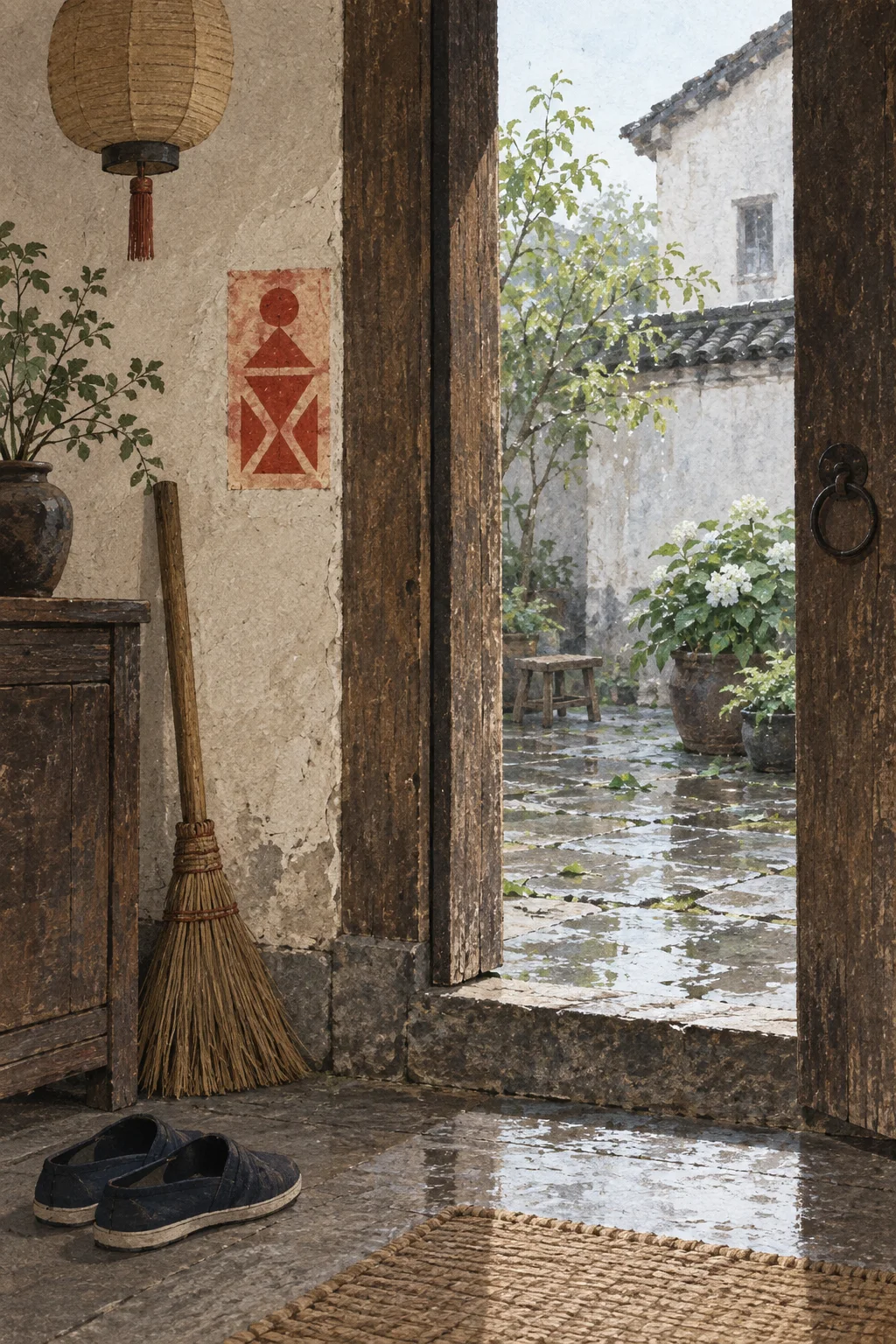
I have spent enough time on paper to know the temptation. You see a printed guardian or a charm at a door and want to make it speak in a grand voice: here is what this people believed; here is what every family did; here is the one meaning of a threshold. The object is so small that the sentence feels satisfyingly large.
The house does not agree. It has its own weather, its own repairs, its own reasons for leaving a lamp on, its own person who comes home late. A protective object may be part of that life without explaining it all. It can be meaningful without becoming a portable footnote for an entire civilization.
A lucky object is not a tiny museum label pasted over a living room.
I do not mean that records are useless. I am very fond of records when they are doing their proper work. A seasonal text can tell us that a practice was noted in a particular place and period. A collection record can tell us about a specific image. A novel can tell us what later readers wanted me to do on a page. Each is a door. None is the whole house.
When a Qing-era Suzhou record places my image in a fifth-month room, I listen. It lets us know that someone wrote down that practice there. It also asks us to keep its place and time attached. When an older regional account preserves protective actions for the fifth month, I listen to that too. It gives the season a wider texture; it does not make every custom mine.
That is not a narrow reading. It is a generous one. It leaves room for the object to have a local life: to be pasted, replaced, ignored, discussed, inherited, or taken down without becoming a test of whether a household belongs to a single imagined tradition.
I am not worried that a smaller claim makes a smaller guardian. I am more useful when I do not have to stand in every doorway at once. Let one paper image belong to one wet morning. Let one text belong to its place. Let the people inside decide whether it is luck, habit, memory, decoration, or all of those things before breakfast.
This is what I have learned from the figures beside me. A named companion belongs to his novel. An attendant belongs first to the object that shows them. A bat belongs to the picture before it belongs to a slogan. And I, even with my stern expression, belong to more than one kind of story.
Next, I will stay after the paper comes down. A threshold is not empty when the guardian has gone; it is full of the ordinary work that made people ask for protection in the first place.
Keep me honest
- Qing jia lu (清嘉录), fifth-month Zhong Kui material. A Qing-era Suzhou record used for a local instance of a Zhong Kui image in seasonal household practice; this episode does not make it a national or timeless rule.
- Jingchu suishiji (荆楚岁时记), fifth-month material. A regional textual route to a broader field of fifth-month protective practices, not proof that every practice involved Zhong Kui or the same object.
- The reading room. The site’s source guide distinguishes a literary text, a custom record, a museum object, and contemporary editorial narration so readers can see what each kind of evidence can establish.