For a while I blamed the calendar. It had sent me to a winter door, then lifted me from it and pinned me above a summer table. A respectable guardian likes a clear posting. One date. One direction. One list of duties written in a hand no one can pretend not to read.
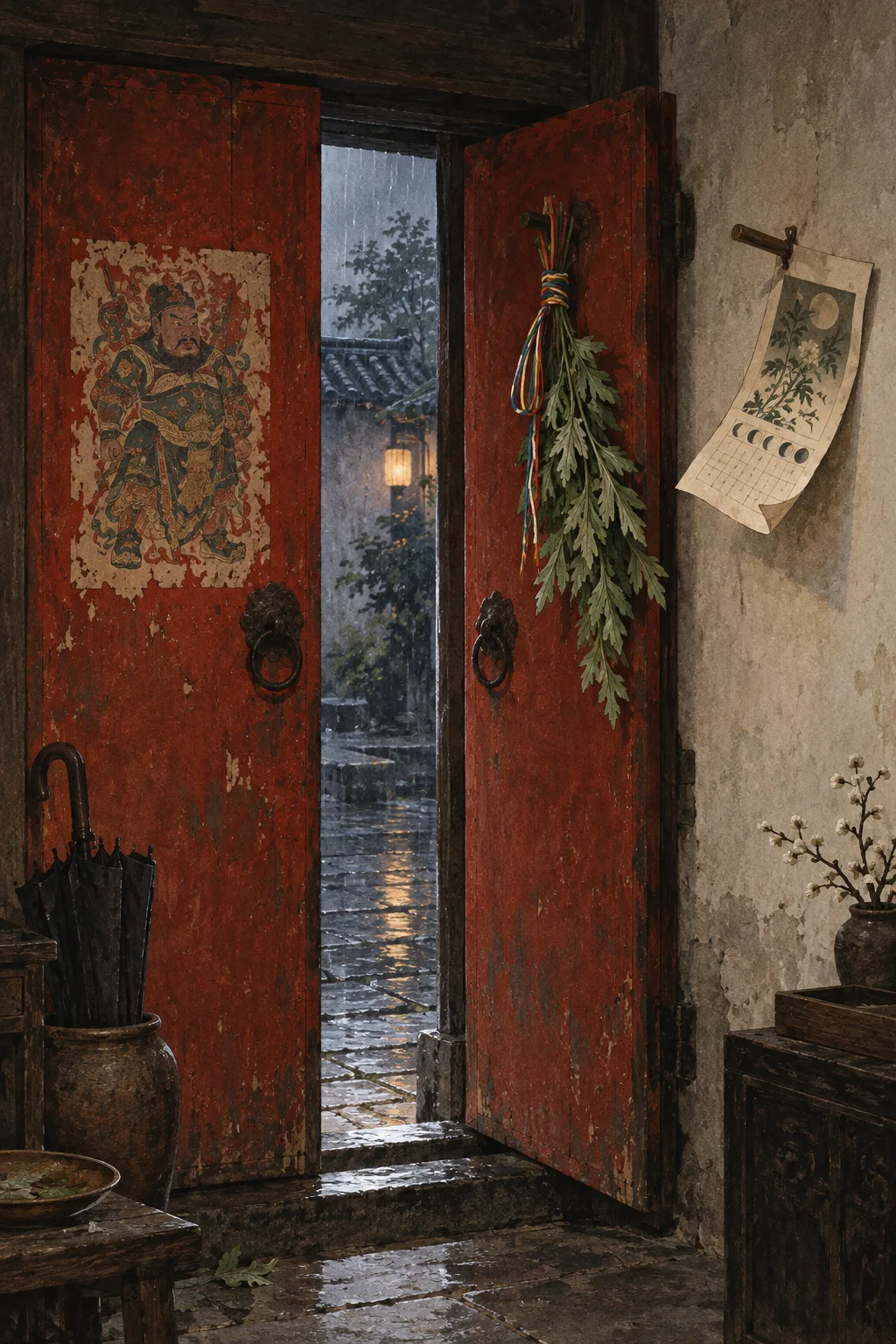
But the door would not cooperate. It had no date on it. It had a latch, two rings darkened by hands, a crack near the bottom where rain found its way in, and the patient look of a thing that has listened to too many people decide what may cross it. A calendar can tell you that a month has changed. A door tells you whether someone is still waiting outside.
At the year’s end, I know the feeling. Rooms are swept, accounts are checked, debts are mentioned in lower voices. People are not only afraid of ghosts. They are trying to gather a difficult year into a shape that can be carried over a threshold. Put a fierce face on the door and, for a moment, the new year arrives with an ally.
In the fifth month the unease sits differently. It is not piled up behind the old year. It comes close: heat that will not lift, rain that will not stop, a cough, a bite, food turning before its time. The household does not need the same answer. It needs a way to notice that the ordinary world has become slightly less ordinary.
A date tells you when a worry is expected. A door tells you where people try to meet it.
That is why I no longer think my return in May contradicts my work at the year’s end. The records do not give me one neat nationwide job description, and I would distrust one if they did. They preserve particular customs, arguments, and images from particular places. The work of joining them belongs to later readers. My work, in this notebook, is to leave the joins visible.
I can feel the temptation to make a grand rule from a small shelf of books: Zhong Kui is this; Chinese households always did that; every red door means the same thing. The temptation has excellent posture and very poor manners. It walks into a room, pushes the local details aside, and calls itself clarity.
I prefer the messier account. A guardian can be a door image, a hall picture, a figure in a story, a name on a festival object, or a face painted for a performance. Each setting asks something a little different. Sometimes I am asked to stand outside the danger. Sometimes I am asked to name it. Sometimes I am only there because a family has inherited a picture and cannot quite bring itself to throw it away.
That last task may be my most human one. A picture stays after an explanation has faded. Someone points at it; someone else remembers a grandmother hanging it; a child asks why the man looks so severe. No text can enter that room for us. It can only tell us that other rooms, in other times, found their own reasons to make a guardian visible.
So I will keep two seasons in my pocket. Winter reminds me that people make a beginning by clearing a boundary. Early summer reminds me that a boundary also has to breathe: leaves, rain, medicine, food, bodies, and the small failures of a house all press against it. Neither season owns me. Both have taught me to stay awake.
There is one question left, and it has been waiting patiently beside the door. If a guardian is never entirely alone, who gets to stand beside him—and who was only placed there by a later story? I have met names in the wood, a sister in a procession, and a companion in a novel. Next, I should learn how to introduce them without inventing a family.
Keep me honest
- Qing jia lu (清嘉录), fifth-month Zhong Kui material. A Qing-era Suzhou record used for the local fifth-month image practice. The article does not treat it as a rule for all regions or eras.
- Jingchu suishiji (荆楚岁时记), fifth-month material. A regional textual route into seasonal protective practices; it supports the wider seasonal context, not a universal Zhong Kui rite.
- Qing jia lu, related year-end and fifth-month discussion. The juxtaposition of the two settings is the basis for this episode’s question. Its first-person reflections are contemporary editorial narration.