“Who?” is a dangerous little word. It arrives dressed as a simple question and leaves carrying somebody else’s life in its pocket. Who put me up? Who took me down? Who first looked at the pale square and thought the room had changed?
I could answer quickly. I could give you a careful grandmother, a restless child, a housekeeper with a cloth over one shoulder, a neighbour who notices everything and pretends not to. They would all make excellent company. They would also be strangers I had invented for the convenience of a paragraph.
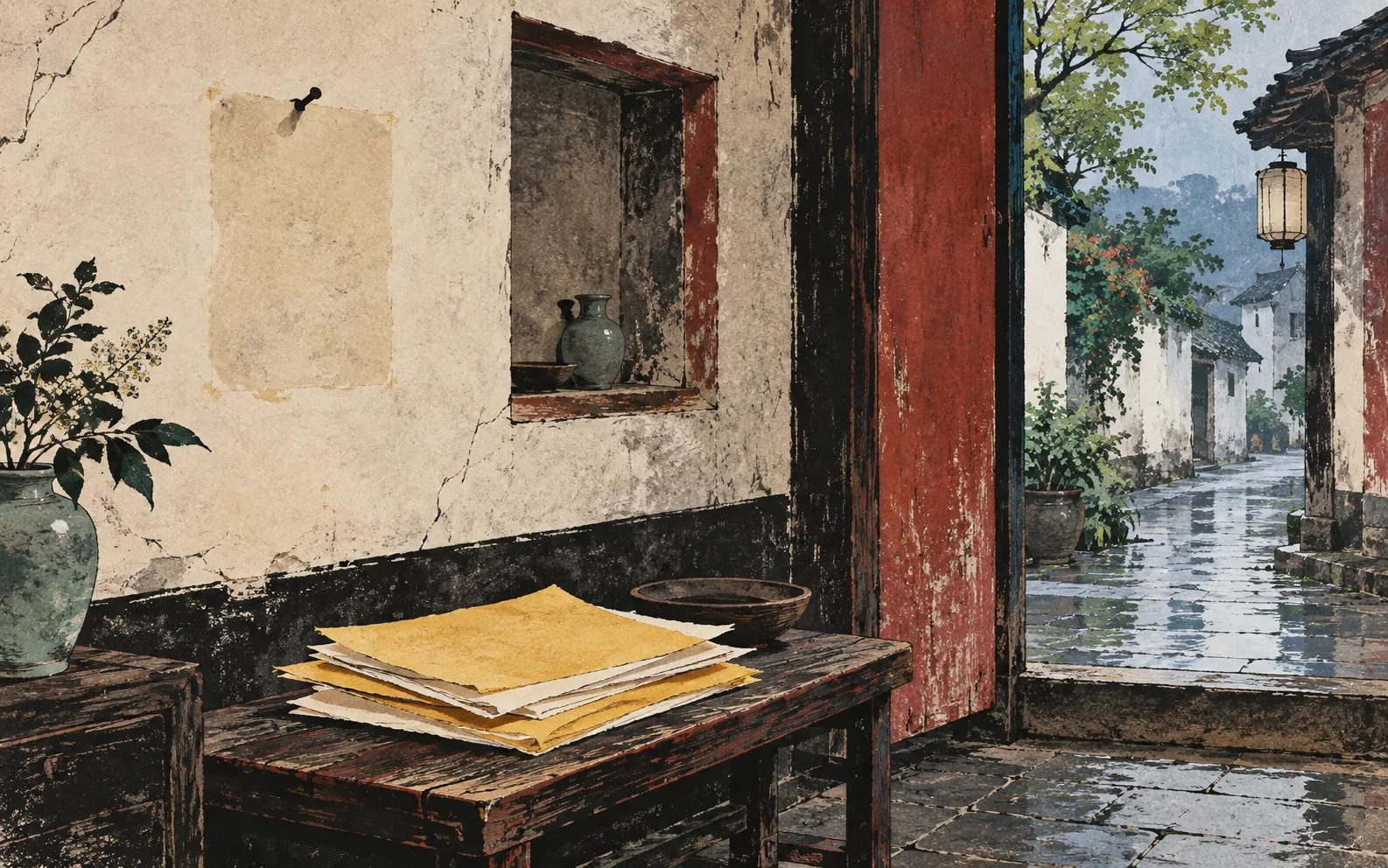
So I will not. An empty wall does not need a cast list. It already has its question. The useful thing about not knowing is that it keeps me from mistaking a picture for an introduction. I can be present in a room without being entitled to everyone who passes through it.
A missing picture does not give me permission to invent the people who once looked at it.
There are places where a picture is one sheet among many sheets, before it ever earns a wall. I find this oddly reassuring. It means I was not born solemn. I could be stacked, selected, passed from a hand, or left behind. A guardian in circulation has to learn that attention is not possession.
Even there, I will not make up the decisive hand. A record can show the public life of paper without taking us into a private room. It can tell us that several protective images appeared in the same seasonal marketplace; it cannot say which one a particular person carried home, where it went, or what silence followed it. The gap is not an empty seat for fiction to occupy wearing historical clothes.
Perhaps the first person to notice the empty wall was nobody. That is allowed. Rooms continue. Meals are cooked. Rain arrives. A door sticks in damp weather and someone has to put their shoulder to it. I do not vanish merely because no one delivers a speech. A season can end without applause.
Or perhaps someone did notice, and said nothing. I like that answer better as a possibility than as a fact. It leaves dignity on both sides of the wall: mine, because I was useful for a while; theirs, because their attention need not become my property.
This is the small lesson I am taking from the empty space. A source can tell me that images moved through public hands. A room can make me wonder about private ones. Between those two things, I should keep my beard out of the gap.
Next I will follow the paper before it reaches the wall. Not to claim a complete journey, but to ask what changes when a guardian is still one image among several.
Keep me honest
- Yanjing suishi ji (燕京岁时记), “Dragon Boat Festival”. This Qing-era Beijing record describes festival-market yellow papers bearing images of the Heavenly Master, Zhong Kui, or Five-Poison charms for hanging and sale. It supports a public marketplace of several protective images, not a claim about a named buyer, a particular household, or anyone’s response after an image was removed.
- Qing jia lu (清嘉录), “Hanging a Zhong Kui picture”. Its Suzhou entry remains this season’s separate local record of a Zhong Kui picture hung in a hall for one month. This note does not merge the Beijing market description with that Suzhou household setting.
- The family roles, rain, door, and inner reflections in this episode are contemporary editorial possibilities. They are not historical identifications.