A wall is a quiet witness, which is why people are always asking it to become a loud one. Look, they say: the nail. Look: the pale rectangle. Surely this proves the whole room once arranged itself around me.
It proves less than that. A nail proves that something was hung. A pale square proves that light and dust have their own opinions. Neither can tell you who stood there, what they feared, or whether they remembered to take me down on a dry day. A wall has excellent patience and dreadful handwriting.
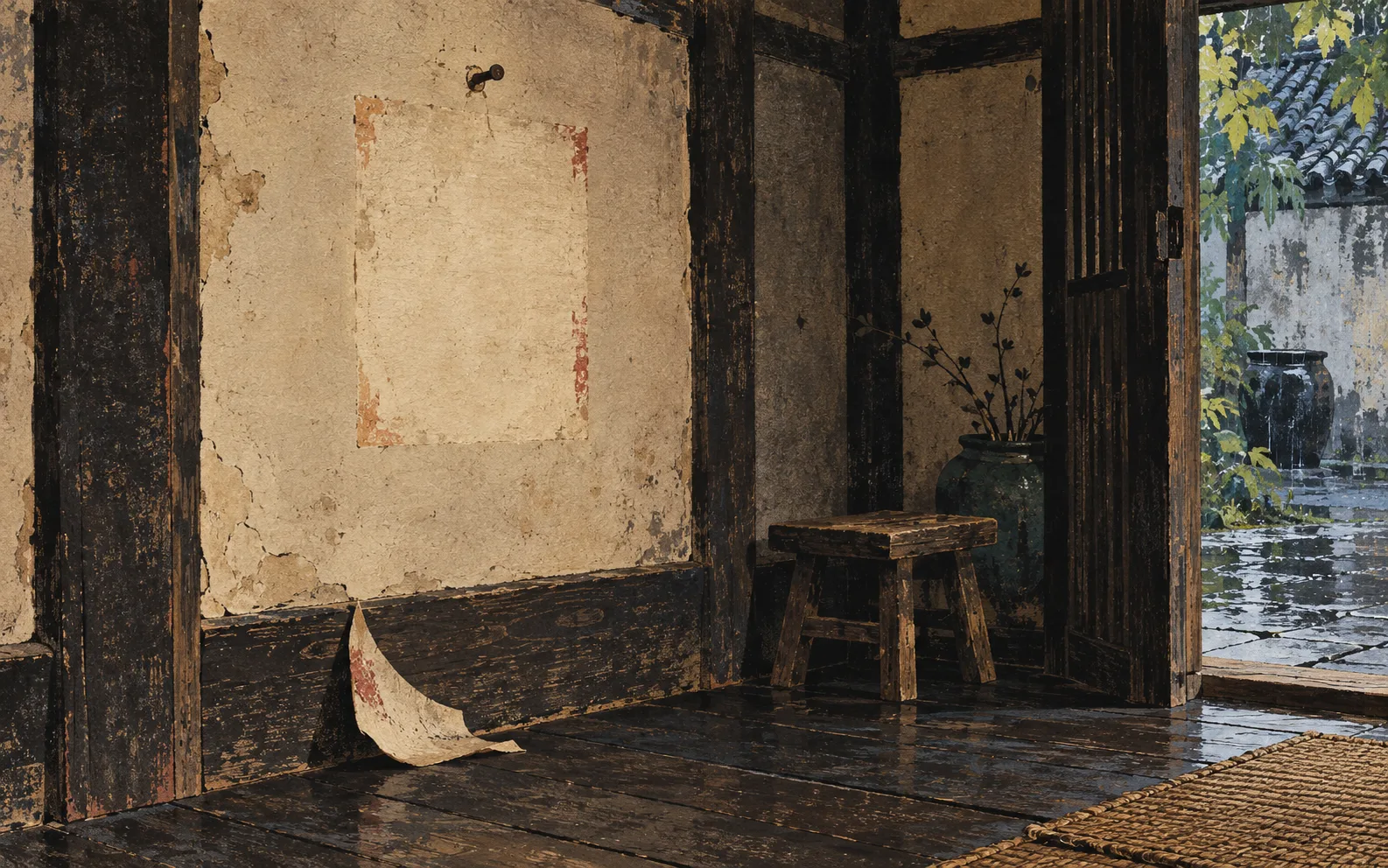
I like that limitation. My name has spent a long time being made to carry more than it can hold: every frightened emperor, every stern face in a print shop, every claim that a doorway once did exactly what somebody wishes it had done. A bare patch of plaster is less ambitious. It says only: something changed here.
A mark can invite a question without answering it for you.
One old address has allowed me a month in a hall during the fifth month. It gives me no wall afterward and no person to take me down. I could make that silence grand if I wished. I could fill it with incense, ceremony, and a perfectly timed breeze. I will spare you. Silence is not an invitation to forge a memory.
Still, a room does change when an image leaves it. This is not a claim about that Suzhou hall. It is only something I understand as a picture myself. The place where I was begins to belong to the light again. The stool stops being a stool placed near my wall and becomes merely a stool. A doorway regains the ordinary duty of admitting wet shoes, poor news, soup, neighbours, and anybody who has forgotten their key.
There is dignity in becoming ordinary again. The picture had a season; the room has the rest of the year. If I have done my work, I do not need the wall to keep reciting my name. The pale square is not a monument. It is a little pause between two kinds of looking.
Perhaps that is what a wall remembers: not a complete story, but the pressure of attention. Somebody once looked up. Somebody chose a place. Somebody later decided the room could continue without a face on the plaster. Those sentences are mine, not an excavation report. I say them because they make room for the people who lived beyond the record, rather than pretending to speak over them.
I am trying to learn the same discipline. I can remain in a tale without occupying all of it. I can be a guardian without becoming the household. I can leave a mark in the mind without asking it to be mistaken for proof.
The next question belongs to the people in the room. When the wall is empty, who notices first—and what do they think they have lost?
Keep me honest
- Qing jia lu (清嘉录), “Hanging a Zhong Kui picture”. A Qing-era Suzhou fifth-month entry records a Zhong Kui picture hung in the hall for one month to ward off malign influences, and its note distinguishes year-end from fifth-month uses. It supports the limited local, seasonal setting carried across this season. It says nothing about wall marks, storage, removal, or private feeling after the image came down.
- This episode’s nail, plaster, rain, stool, and reflections are contemporary editorial narration. They are deliberately not presented as recovered evidence about a historical household.