I have been left on a wall longer than anyone meant to keep me there. This happens. A season changes its mind. A household gets busy. A chair is placed in front of the nail. A person looks up, says “tomorrow,” and then the weather makes a liar of tomorrow.
I do not take it personally. Paper has better things to do than keep a strict diary, and so do people. Still, there is a difference between being welcomed for a while and becoming part of the wallpaper. A picture may be brave; it ought not to become furniture.
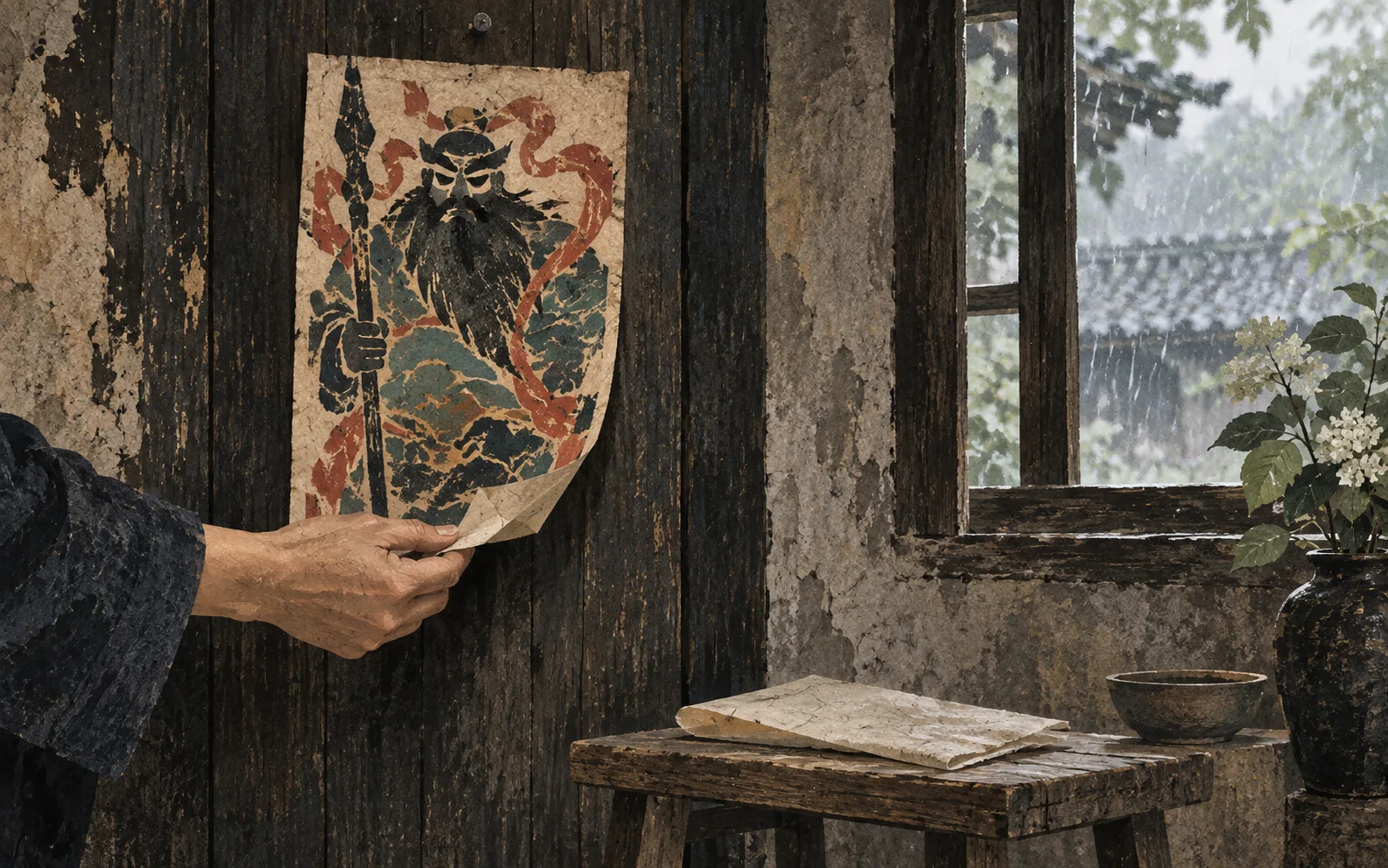
I have one small piece of evidence for this impatience: somewhere in Suzhou, during a fifth month recorded in a Qing book, a Zhong Kui picture was put up in the hall for one month. That is a useful sentence. It has a place. It has a season. It has a limit. It does not make me manager of every calendar in China, which is fortunate; I already have enough trouble keeping my beard in order.
A month is not a commandment. It is the length of one recorded welcome.
The sentence stops there. It does not tell me who loosened the paper, whether they folded it, whether the rain had begun, or whether anyone said goodbye. I admire a source that knows where to stop. The rest is not missing evidence waiting for me to dress it in a handsome robe. The rest belongs to the people who stood in that room, and I was not there to borrow their hands.
So let me be plain: I cannot give you an ancient removal ceremony. I cannot promise that every picture came down after the same number of days. I cannot tell you that a bare nail meant neglect, or that a folded sheet of paper meant gratitude. Those would be nice, confident details. They would also be mine, not theirs.
But the limit matters. To hang a picture for a while is to admit that protection can be seasonal. It can answer a particular weather, a particular fear, a particular stretch of the year, and then make room for ordinary life again. This is not an insult to a guardian. It is a compliment. A guardian who stays forever begins to confuse vigilance with ownership.
I like the thought of being taken down carefully. Not dismissed. Not defeated. Just relieved of a shift that had an end. A hand catches the lower corner. The wall has a paler rectangle where I stood. The room looks larger for a moment. Someone notices it can breathe without me staring at it.
That last room is mine to imagine, not yours to mistake for a recovered scene. What the record gives us is modest and complete: a picture, a hall, one month. Sometimes modest evidence is enough to improve the way we tell a story. It teaches a painted guardian to leave on time.
Once I am gone, however, the wall is not empty. It has a pale mark, a nail, perhaps a little dust, and the memory of someone looking up. Next I want to ask what a wall remembers after the picture has stopped speaking.
Keep me honest
- Qing jia lu (清嘉录), “Hanging a Zhong Kui picture”. A Qing-era Suzhou fifth-month entry says that a Zhong Kui picture was hung in the hall for one month to ward off malign influences. Its editorial note compares year-end and fifth-month uses and explicitly treats them as different. It records a duration; it does not describe a removal ceremony or establish a national rule.
- Qing jia lu, fifth-month context. The same entry sits among other fifth-month material. The hand, rain, wall, nail, and reflections in this note are contemporary editorial narration, not claims about a historical Suzhou household.