I used to think a door became ready the moment somebody put my face near it. I had a sword, a very respectable beard, and the kind of expression that discourages small spirits from asking follow-up questions. It seemed an efficient arrangement.
Then I began to notice the company. A paper charm leaned a little crookedly beside me. A bundle of leaves dried above the lintel. A lamp waited on a stool. Shoes were brought in before the rain made a lake of the step. Nobody had appointed these objects my assistants, which was a relief. They had their own work, their own seasons, and no obligation to salute when I arrived.
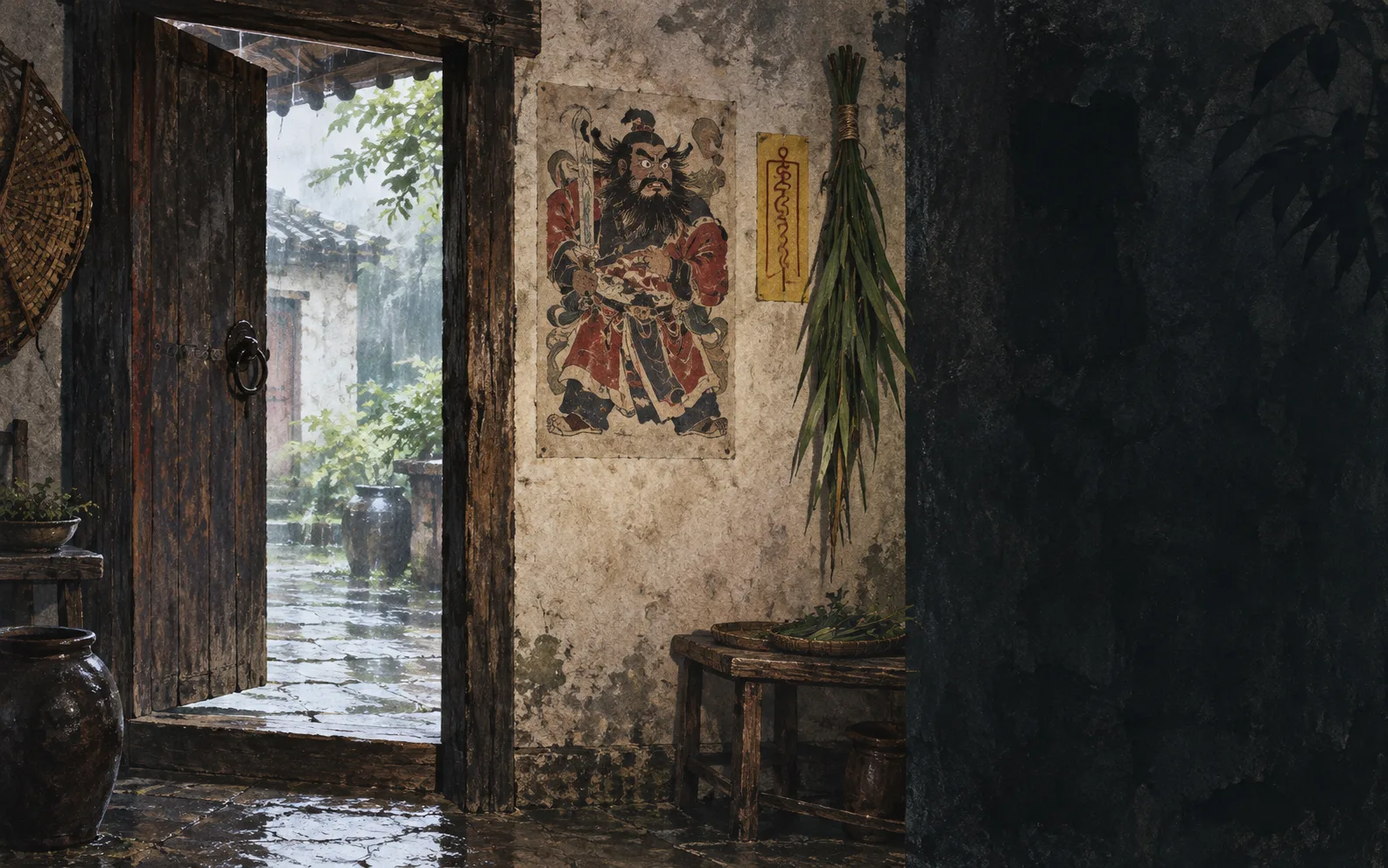
This is better than a throne. A throne demands an audience. A door asks whether the room is ready for what comes through it. Sometimes that means keeping a worry outside. Sometimes it means making a space for a wet coat, a late guest, or a child who has lost the courage to knock. A guardian who cannot tell the difference is only posing.
A house is not protected by one object pretending to be the whole house.
I have been given too much credit in my long life. People look at a printed face, see a weapon, and imagine a complete answer to every bad thing. It is flattering for about three minutes. Then the roof leaks, somebody gets ill, an argument crosses the room, and I am reminded that a picture cannot cook rice, listen well, or repair a latch.
The small arrangements interest me more. A doorway does not become serious because its objects match. It becomes serious because somebody has noticed the season and decided not to meet it empty handed. The paper may be fresh or faded. The leaves may smell sharp or have gone brown. The lamp may be practical rather than sacred. None of that makes the gesture small.
I will not claim that every household arranged its threshold this way, or that every place asked the same question of summer. A custom has an address. So does a worry. What I recognise in these crowded edges is not one ancient instruction, but a modest instinct: do not leave the entrance unattended when the world feels difficult.
There is a useful humility in sharing the wall. I can stand beside a charm without becoming the charm. I can stand near leaves without borrowing their scent. I can be part of an effort without claiming to have invented it. For a man often painted much too large, this is excellent training.
So this is what makes a doorway ready, at least for tonight: not my face alone, but attention. A person has looked at the threshold, remembered the weather, put a few things in their places, and left room for someone expected to return. I can guard that kind of care without taking credit for it.
Next I want to ask a less comfortable question. If a picture is hung for a season, how does it know when it is time to come down?
Keep me honest
- Qing jia lu (清嘉录), “Hanging a Zhong Kui picture”. A Qing-era Suzhou record says that a Zhong Kui picture was hung in the hall for one month to ward off malign influences. Its surrounding editorial discussion also distinguishes year-end and fifth-month uses. This episode treats it as one local record, not a universal household blueprint.
- Yanjing suishi ji (燕京岁时记), “Dragon Boat Festival”. Its Beijing market description lists yellow papers carrying images of the Heavenly Master, Zhong Kui, or Five-Poison charms for hanging and sale. It supports the article’s crowded visual field, not a claim that these objects belonged together in one fixed rite.
- Qing jia lu, fifth-month entries. The same local chapter records several other May practices. The rain, lamp, household, and first-person reflections above are contemporary editorial narration rather than a recovered scene.