I once tried to hang a footnote on a door. It was a neat little thing, beautifully numbered, full of dates and careful limits. The nail went through it at once. Rain reduced the rest to a pale curl. This was not the footnote’s fault. It had been asked to guard a threshold, which is not what footnotes are for.
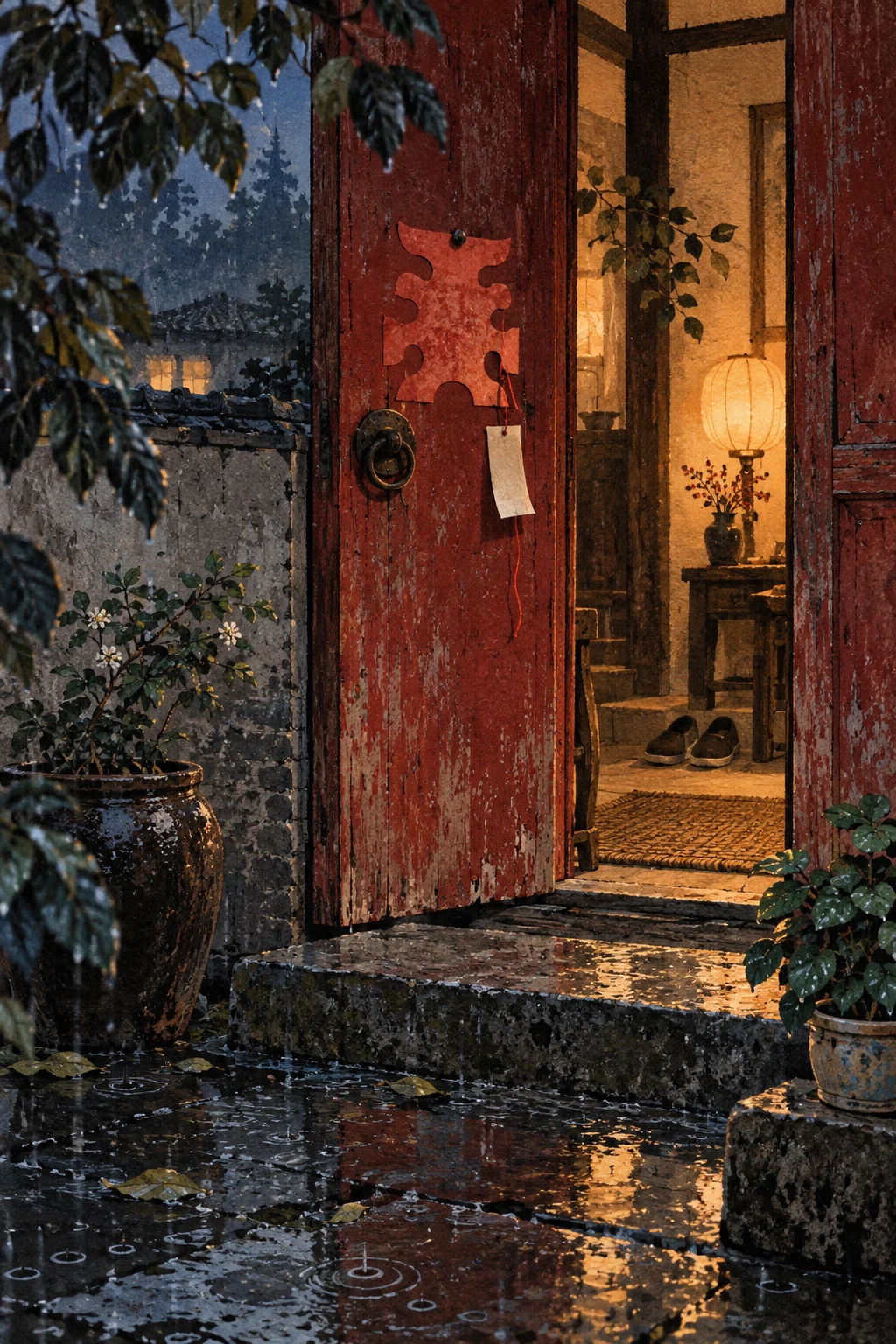
A door does not ask for a theory before it opens. It asks whether the stone is slick, whether the lamp has gone out, whether someone is late, whether a child has remembered the key. The objects near it acquire their weight from hands, weather, repetition, and the private calculations of a household. I can respect that without pretending that every red paper shape carries my name, or that every family has inherited the same instructions.
A note can tell you where a door was described. It cannot tell you what the rain sounded like there.
This is why I keep the citations beside the story rather than nailing them over it. They tell us that a practice was recorded in a particular place, at a particular time, with particular words around it. They warn us when a useful image has been stretched too far. They do not supply the sound of the latch, or decide whether an image should remain after the person who hung it has gone.
I am fond of this division of labour. The record holds its line. The door holds its weather. A reader who wants to know more can follow the line back to the page. A person standing in a damp hallway can still decide that tonight the important thing is to bring the shoes in, dry the sill, and leave a little light for whoever is expected.
There is danger in the opposite direction too. People sometimes call a gesture ancient because it feels old, or universal because it feels familiar. A threshold is very good at making a small habit seem like the architecture of the world. I do not blame it. Thresholds are dramatic by trade. But this is where the modest footnote returns, dry and patient, to say: this was recorded here; do not make it speak for everywhere.
So I will not hang the footnote again. I will keep it within reach, where it can do the work it was made for. The door can keep its rain. The page can keep its place. Between them, perhaps, I can remain both useful and honest.
Next, I want to ask what makes a doorway ready—not in every city or century, but in the small, changing arrangement of a particular season.
Keep me honest
- Qing jia lu (清嘉录), fifth-month Zhong Kui material. A Qing-era Suzhou record used here to ground one local image practice; it does not establish a universal household custom.
- Jingchu suishiji (荆楚岁时记), fifth-month material. A regional textual route into seasonal protective practices; it supports context, not a single nationwide rite.
- Qing jia lu, related year-end and fifth-month discussion. The contrast between settings is the basis for this episode’s question. The first-person reflections are contemporary editorial narration.