The space beside me is often occupied before I arrive. This ought to be obvious, but I have been painted large for so long that some people expect the threshold to clear its throat and move the furniture when I appear.
Two older names have their own business at the gate. They are not waiting to be introduced to me. They do not need my sword, my temper, or my opinion about beard maintenance. A door can have more than one keeper without becoming anyone’s family reunion.
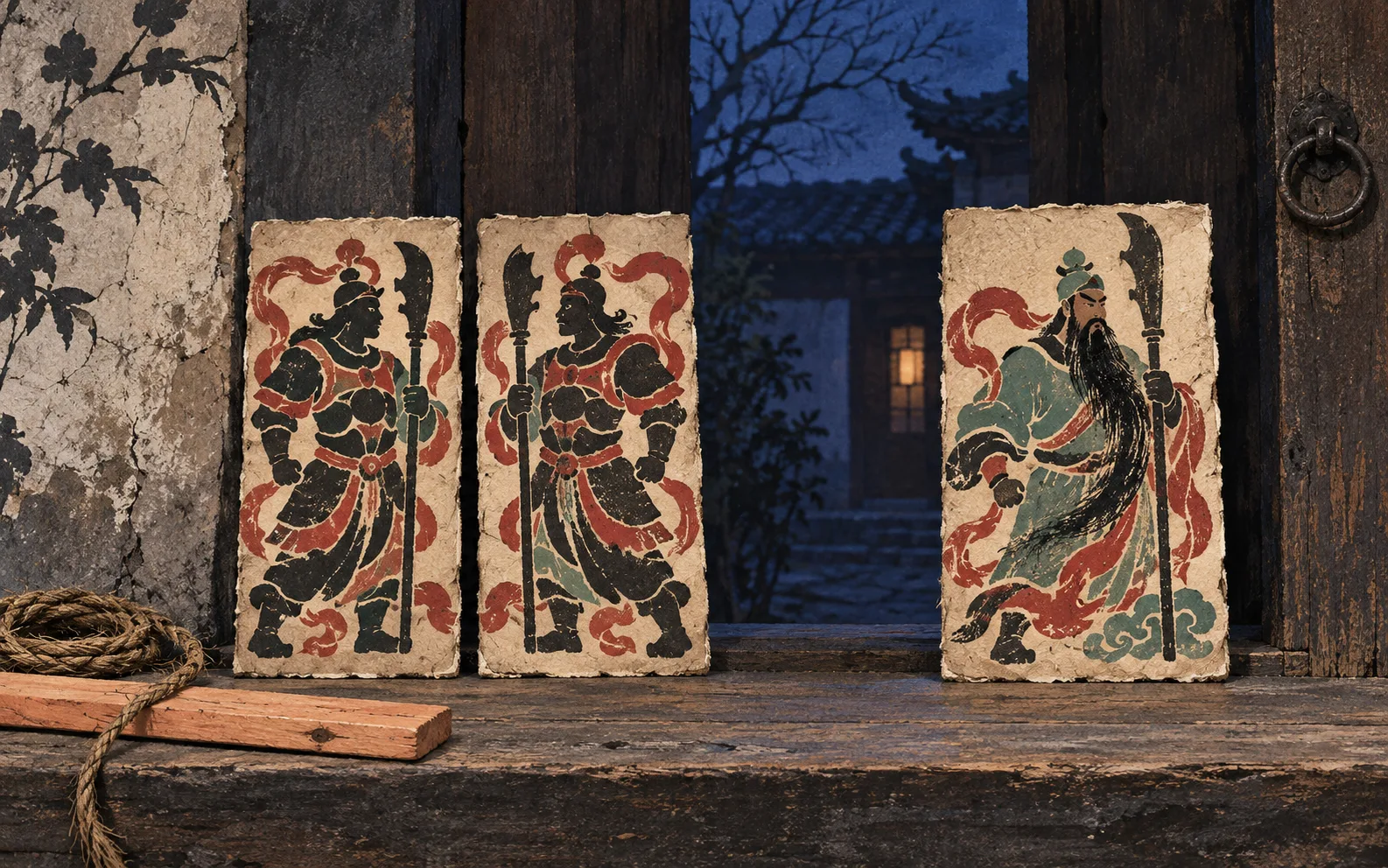
I have learned to like the empty air between us. It prevents an easy mistake: if several figures are called on to guard a doorway, surely they must have one captain, one origin story, and a sensible rota. That is how offices are organised. Traditions are less tidy.
To share a door is not to share a biography.
There is an older pair whose names travel with a gate, a peach tree, and the sorting of troublesome ghosts. Their story belongs to them. I can stand nearby without absorbing it. Later, in one city’s New Year list, door gods, a peach charm, and I are named in the same breath. That is company, not a command chart.
Of course, a storyteller once found this restraint unbearable and put the pair behind me in a marching line. It is a lively scene. I look very good in it. But a later tale is allowed to make a cast; it is not allowed to walk backward through time and rename every older guardian as my subordinate. I have enough imaginary employees already.
The distinction matters because it changes the question we ask of a threshold. Not “who is in charge?” but “what kinds of protection have people imagined here?” One name may be tied to an old gate story, another to a seasonal household record, another to a vernacular adventure. They can touch at the doorway without being made into one creature.
So leave us room. Let the pair keep their own old horizon. Let me keep the images and stories that made me useful. Let the later storyteller enjoy his procession. The space between us is not a failure of the picture. It is where the differences remain legible.
I began this season by asking what can come home. I think the answer is now less lonely than I expected: several things can stand near a door, provided none of them is forced to swallow the others’ history.
Next I want to look at what happens after a name becomes visible. A name can travel farther than a face, and a face is never as settled as a label suggests.
Keep me honest
- Bencao gangmu (本草纲目), “Peach charms”. This Ming compendium cites an older Han jiuyi account of Shenshu and Yulei guarding the ghost gate and of peach boards at a door. It establishes a distinct transmitted guardian tradition; it does not make them Zhong Kui’s kin or attendants.
- Meng liang lu (梦粱录), “New Year’s Eve”. A Southern Song Hangzhou entry lists replacing door gods, hanging Zhong Kui, and nailing peach charms. It records local co-occurrence, not a shared genealogy, position, or hierarchy.
- Tang Zhong Kui ping gui zhuan (唐钟馗平鬼传), chapter 16. This later vernacular tale calls Shenshu and Yulei Zhong Kui’s followers. It supports that relationship inside this particular fiction only, not an older or universal family tree.
- The spacing, panels, doorway, and first-person reflections are contemporary editorial narration. The illustration is not a historical display or a reconstruction of a single practice.