Before I reach the wall, I am not necessarily impressive. I may be folded. I may be one image among other images. I may have to wait while a doorway is swept, a piece of wood is found, or somebody decides which small worry deserves attention first. This is good for me. A guardian with too much confidence becomes exhausting at breakfast.
I have stood in one old crowded sentence beside a change of door gods and a peach charm at the door. It is a useful place to stand: not at the centre, not alone, and not permitted to claim the whole threshold as my private office.
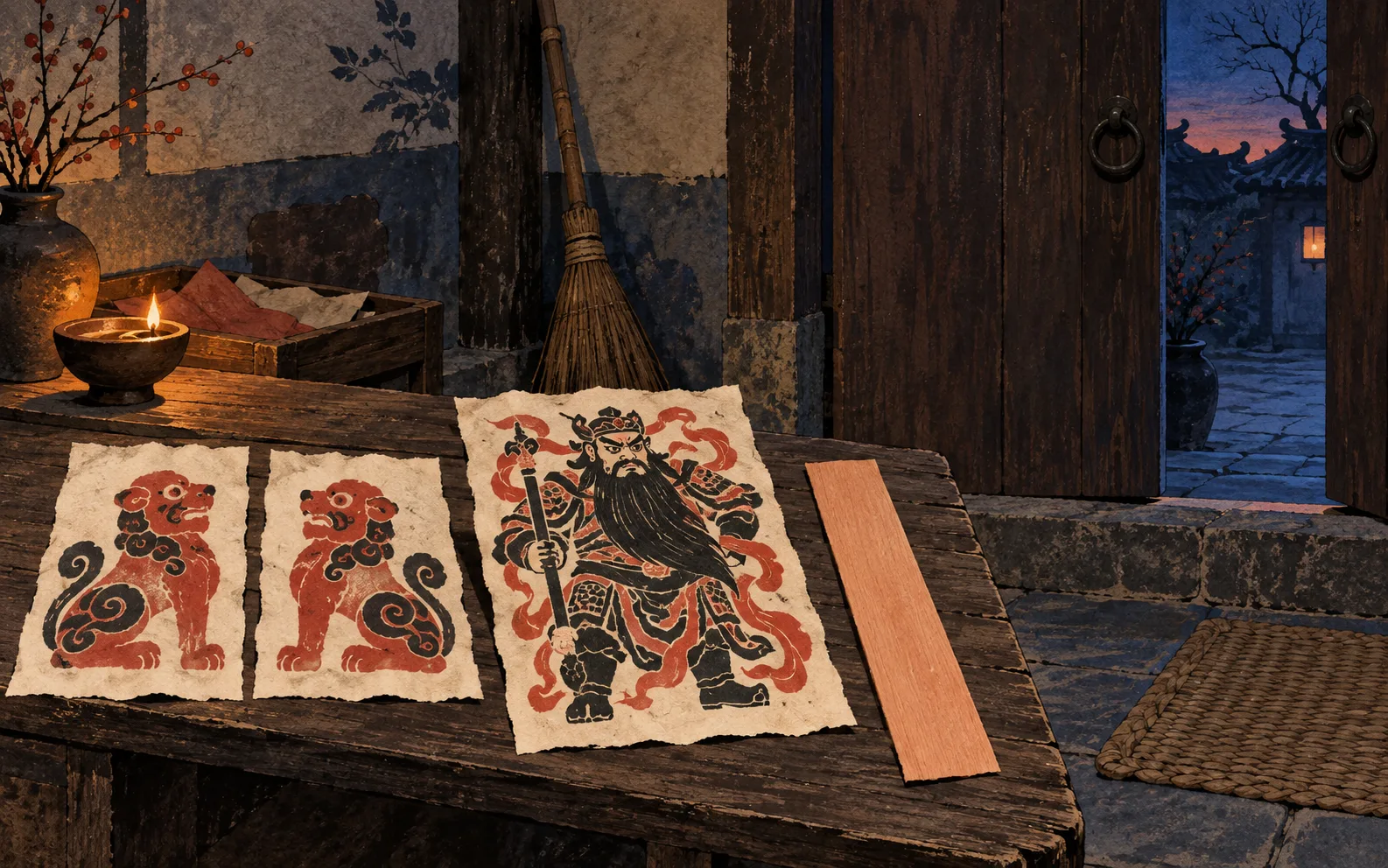
It would be very satisfying to turn that sentence into a complete scene. I could tell you exactly where each object lay, which one went up first, and how the room looked before the door closed. Please do not let me. A list can show company. It cannot draw a floor plan. It can name things used in one place and season without giving us their positions, their makers, their cost, or a route from stall to wall.
To be named with other guardians is not the same as being made master of their doorway.
This is a relief. There are plenty of versions of me that arrive as though a sword settles every question. I prefer the smaller moment before that: a threshold being prepared by more than one gesture, each with its own shape and its own limit. Someone changes an old image. Someone hangs another. Something is fixed to the door. The doorway becomes busy without becoming a machine.
In another place, at another festival, I appear among papers whose companions wear other names. That record does not become the first one merely because I would like a tidy journey. Two crowded scenes may rhyme without belonging to the same household, calendar, or city. I have learned to keep the addresses on the envelope.
So I will not offer you a maker with ink on their fingers, a shop with a clever sign, or a buyer who carries me home under one arm. Those are handsome details. They are also beyond what these notes give us. The life before the wall is not blank; it is simply not mine to finish for you.
What I can keep is the scale of the thought. A picture is not born on a nail. Before anyone asks it to guard a room, it occupies a public world of other images, other objects, and choices that do not need my face to be important. That is where humility begins: not at the moment I leave the wall, but before I get there.
Next I want to look at the space beside me. Not who belongs to me— I have made enough mistakes with that question—but what changes when a threshold makes room for more than one protective figure.
Keep me honest
- Meng liang lu (梦粱录), “New Year’s Eve”. In a Southern Song Hangzhou New Year’s Eve entry, households clean their gateways, replace door gods, hang Zhong Kui, and nail peach charms. This supports a particular crowded list of threshold practices. It does not specify an arrangement, sequence, maker, price, or a general rule for all places.
- Yanjing suishi ji (燕京岁时记), “Dragon Boat Festival”. A Qing-era Beijing market record lists yellow papers with images of the Heavenly Master, Zhong Kui, or Five-Poison charms for sale and hanging. It is a separate city and festival from the Meng liang lu entry; this episode does not combine them into one historical route.
- The bench, lamp, paper arrangement, broom, and first-person reflections are contemporary editorial narration. Generated art here is illustration, not a reconstruction or source object.