The first thing a guardian learns is that people remember the sword. The second is that someone has to carry the rest. A banner does not unfold itself. A bundle does not arrive at the door on its own. In pictures, I am often given a companion small enough to be overlooked and useful enough to make the entire scene possible.
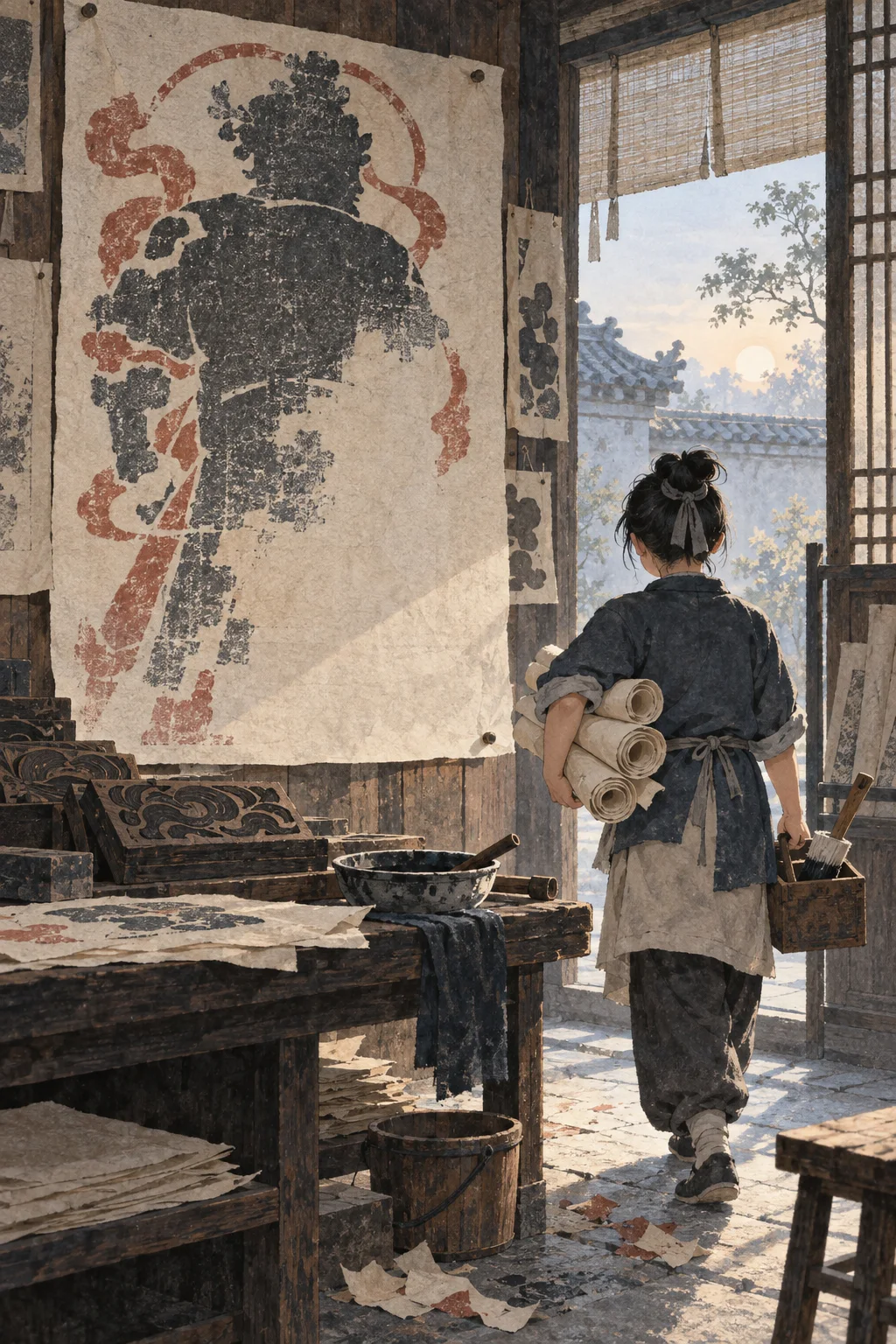
It would be satisfying to gather all those figures into one tidy person. Give him a name, a uniform, a wage, perhaps an unfortunate appointment to a family tree. I understand the urge. A story with named people feels as though it can be carried home in a pocket.
But an attendant in a painting is first an attendant in that painting. The maker has arranged bodies, objects, and attention in a particular way. A small figure may bring scale to a large one. A bat may pull a lucky meaning into the scene. A banner may tell us that a procession is moving rather than posing. These are visual jobs before they become biographies.
The corner of a picture is not empty simply because no one has introduced it.
This is not an argument for treating the smaller figure as furniture. Quite the opposite. A person at the edge of an image can tell us where the image expects our eye to travel, what it wants the central guardian to seem capable of, and how a household object turns a fierce face into a scene with company. That is already a great deal of work.
I have seen readers lean toward a print and ask, “Who is that?” Sometimes the best answer is not a name but a better question: which object is this; who made it; when; what does the catalogue call the smaller figure; and what can we see without pretending that we know more than the object can tell us?
That answer asks a little patience of everyone. It also keeps the image alive. If every attendant becomes the same invented man, then a woodblock print, a hanging scroll, and a modern stage image all become background for one made-up biography. The actual variety disappears just when it has begun to be interesting.
So I am not promoting anybody today. I am only noticing the labor of the edge: the hand that holds the thing, the body that gives the guardian a measure, the companion who turns a lone emblem into a moving picture. An unnamed figure may not be a secret waiting for us to solve. They may be an invitation to look longer.
Next, I have a smaller problem. A bat keeps appearing near me, and everyone assumes it is there for the same reason. Bats are excellent at arriving with too much meaning. I intend to ask what an image can actually promise before I offer it a congratulatory title.
Keep me honest
- The Metropolitan Museum of Art, Zhong Kui accompanied by an attendant and a bat, CP269. A specific collection object whose title establishes an attendant and a bat in that work; it does not identify the attendant as a historical person or a recurring character across all images.
- The Metropolitan Museum of Art, Demon queller Zhong Kui with demons, 2008.636. A separate object record used to keep another visual grouping distinct rather than collapsing every surrounding figure into one companion.
- Why do my portraits disagree?. This site’s object-reading note explains why collection records, dates, materials, and individual compositions matter before symbolic interpretation.