I made the mistake of asking a practical question. If Shenshu and Yulei are a pair, who stands on the left and who stands on the right? I assumed a door, being made of wood and hinges, would offer a dependable answer.
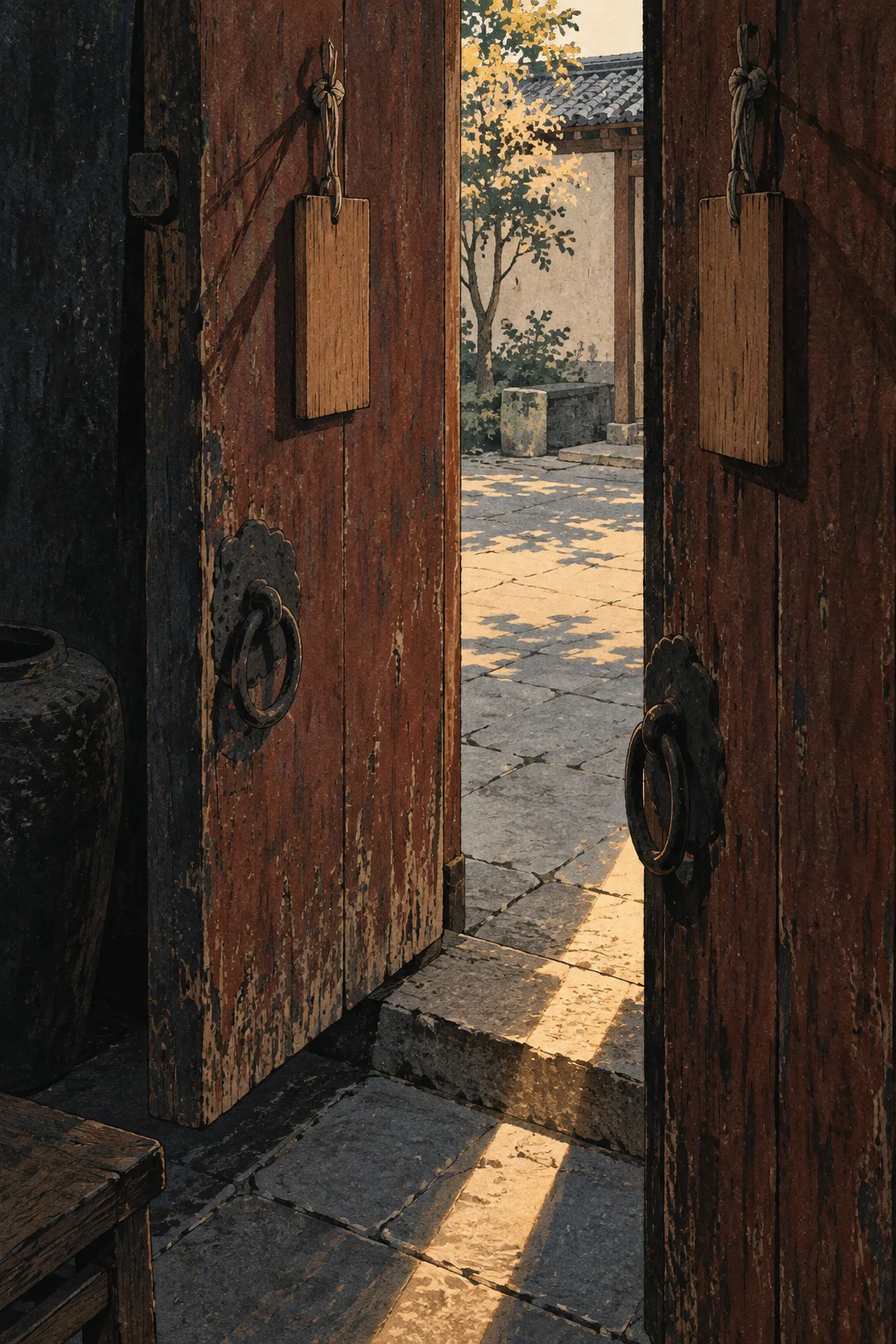
The answer, naturally, depends on where you are standing. Face the door from the street and your left is not the left of the person inside. Stand within the house and look out, and the entire argument politely changes sides without moving a single plank.
There are old discussions with enough confidence to make a man suspect a fight broke out beside a very small gate. One places one name to the left, another reverses the order, and a third seems to have decided that the names themselves were not done changing. I admire such determination. I also decline to settle it with my sword.
A guardian who insists on one position may only be guarding his own point of view.
It is tempting to laugh at this, but I have spent enough time at thresholds to know the trouble is real. A visitor sees an entrance. A household sees an exit. The person returning late sees relief. The person locking up sees responsibility. Nobody is standing in quite the same place, even when all of them are looking at the same door.
Perhaps that is why a pair makes sense. One guardian watches the road coming in; another remembers what the road leaves behind. Their names can trade places in a text without their work becoming useless. The door does not stop being a door because the reader has crossed the room.
I will keep my own place modestly. There is room for a sword, a rope, a lamp, a paper charm, and a person who knows when to open the door. Next I want to know why, when the fifth month arrives, people bring my picture back into the room.
Keep me honest
- Jianhu ji, “Shentu Yulei”. This later discussion records variant left/right order and variant names; the episode turns that disagreement into a question of viewpoint rather than claiming a final arrangement.
- Qing jia lu, “Shentu and Yulei”. It records the paired names in doorway practice and situates them within New Year protective custom.
- Lushi, “Shentu Yulei nuo”. Its compilation demonstrates that the two figures’ names and explanatory traditions were transmitted in more than one form.