I had begun to understand the arrangement. The year thins out. A household looks at its door. Someone remembers that bad luck has excellent timing. Up I go: stiff paper, stern face, no opportunity to ask whether the wall agrees with me.
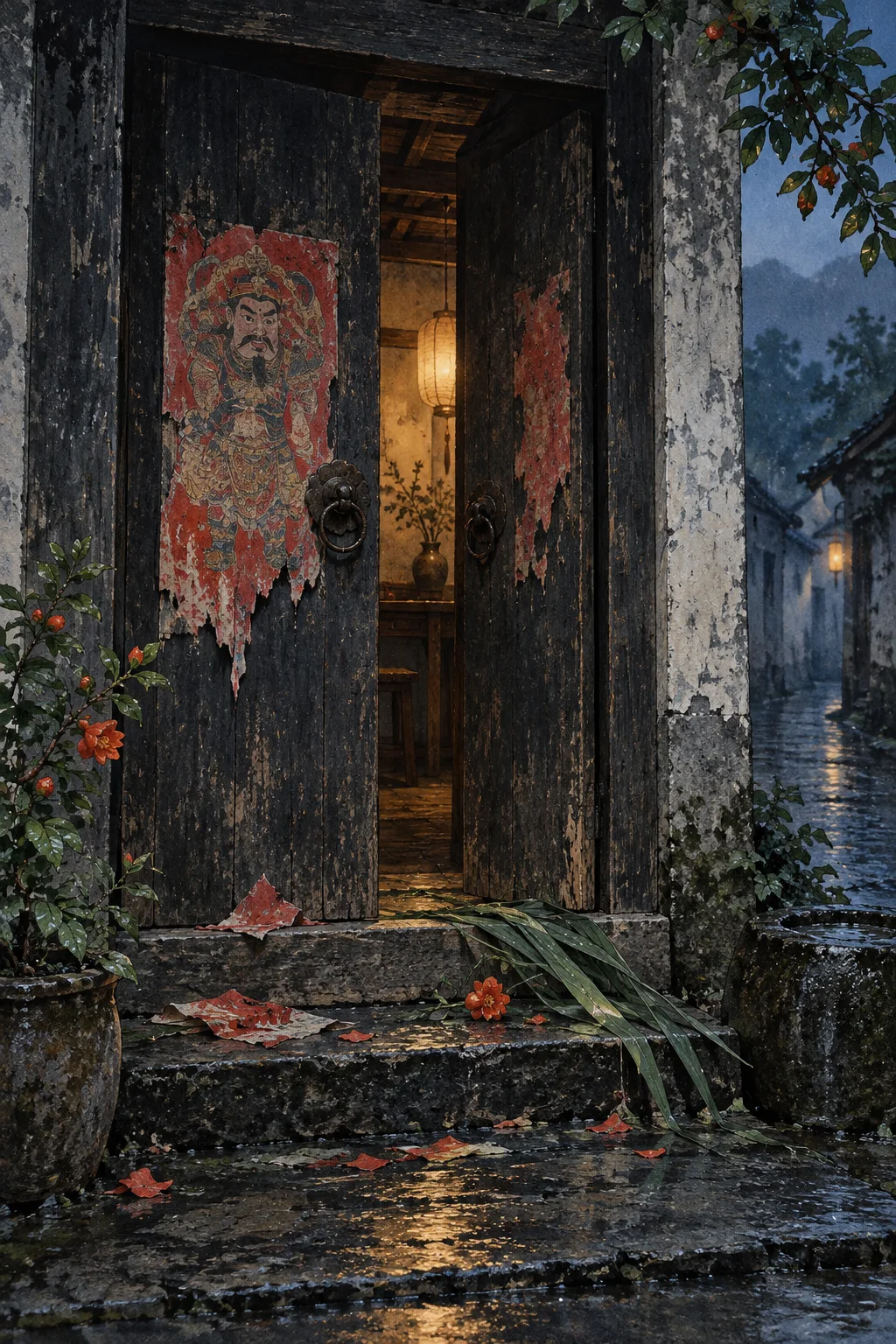
Then the weather changes. The old red scraps are gone from the street. The door is damp with summer rain. There are sharp green leaves near the sill, a bright flower that has no interest in winter, and there I am again—called back to work by people who clearly do not believe a guardian deserves a quiet off-season.
I do not mind being useful twice. What unsettles me is the assumption that the two invitations must mean the same thing. Winter asks a door to survive an ending. Early summer asks it to hold its breath through heat, illness, noise, and the worries that arrive when a year is no longer new. The picture may look familiar. The fear standing behind it does not.
A door remembers the season even when the guardian pretends not to.
I have been tempted to claim every threshold that bears my face. It would make a very impressive résumé. It would also be false. Customs travel unevenly. One household hangs me. Another writes other names. One city asks for me at the year’s turn; another meets me when the fifth month comes around. A painted guardian is not a universal employee.
That thought is a relief. I do not have to be everywhere in order to matter somewhere. The door does not need one grand answer. It needs attention from the people who live behind it: the lamp replaced, the wet stone noticed, the late traveller let in.
So I will stop calling this a winter job. I am a visitor in a calendar that keeps changing its mind. Next, I want to meet the other figures who have been posted near the doors, carrying their own names and their own very old instructions.
Keep me honest
- Qing jia lu, “Hanging a Zhong Kui picture”. The Qing Jiangnan seasonal record describes a Zhong Kui picture hung in the hall during the fifth month to dispel malign influences; it also discusses the relationship between year-end and Dragon Boat uses.
- Qing jia lu, “Shentu and Yulei”. Its discussion of New Year doorway practice shows that Zhong Kui appears within a wider, varied ecology of protective names and images.
- Jingchu suishiji, surviving material on the fifth month. This supports the seasonal context of protective plants and anti-illness practices, not a claim that all such customs involved Zhong Kui.